-
3/23/26, 8:30 AM
-
Douglas Higinbotham (Jefferson Lab)3/23/26, 8:55 AM
-
Wally Melnitchouk (Jefferson Lab)3/23/26, 9:00 AM
-
Jens Dilling (Jefferson Lab)3/23/26, 9:35 AM
-
Eric Voutier (Université Paris-Saclay - CNRS/IN2P3/IJCLab)3/23/26, 9:50 AM
-
Farida Selim (Arizona State University)3/23/26, 10:00 AM
-
Kevin Jordan (Jefferson Lab)3/23/26, 11:00 AM
-
Yves Roblin (jefferson lab)3/23/26, 11:30 AM
-
Alex Bogacz (Jefferson Lab)3/23/26, 12:00 PM
-
Max Bruker (Jefferson Lab)3/23/26, 1:45 PM
-
Victor Manuel Lizarraga-Rubio3/23/26, 2:15 PM
-
Karl Smolenski, Karl Smolenski (Xelera Research LLC), Karl Smolenski (Cornell University)3/23/26, 2:45 PM
-
Silviu Covrig Dusa (Jefferson Lab)3/23/26, 3:45 PM
-
Yu Morikawa (KEK)3/23/26, 4:15 PM
-
Alex Weiss (University of Texas at Arlington)3/24/26, 8:45 AM
-
Marcel Dickmann (University of the Bundeswehr Munich)3/24/26, 9:15 AM
-
Yuki Fukaya (Japan Atomic Energy Agency)3/24/26, 9:45 AM
-
Ricardo Helm (University of the Bundeswehr Munich)3/24/26, 10:45 AM
-
Johannes Mitteneder (Universität der Bundeswehr München)3/24/26, 11:15 AM
-
Jorge Piekarewicz (Florida State University)3/24/26, 1:45 PM
-
Paul Gueye (Facility for Rare Isotope Beams/Michigan State University), Paul Gueye (FRIB/MSU)3/24/26, 2:15 PM
-
Bogdan Wojtsekhowski (Jefferson Lab)3/24/26, 2:45 PM
-
Marco Battaglieri (JLab/INFNGE)3/24/26, 3:45 PM
-
Weizhi Xiong (Syracuse University)3/24/26, 4:15 PM
-
Donovan Newson3/25/26, 8:45 AM
-
Yasuyuki Nagashima (Department of Physics, Tokyo University of Science)3/25/26, 9:15 AM
-
Kenji Shu3/25/26, 9:45 AM
-
Matthew Stoneking3/25/26, 10:45 AM
-
Tim Gay3/25/26, 11:15 AM
-
Christian Weiss (Jefferson Lab)3/26/26, 8:45 AM
-
Concettina Sfienti (University of Mainz)3/26/26, 9:15 AM
-
Kate Scholberg (Duke University)3/26/26, 9:45 AM
-
Doris Jakubassa (University of Munich)3/26/26, 10:35 AM
-
Matteo Ronchi (Johannes Gutenberg University)3/26/26, 11:05 AM
-
Cornelis Mommers3/26/26, 11:35 AM
-
Yoshinori Enomoto (KEK)3/26/26, 1:45 PM
-
Spencer Gessner (SLAC)3/26/26, 2:15 PM
-
Branislav Vlahovic (North Carolina Central University)3/26/26, 2:45 PM
-
Sophie Crisp (SLAC National Accelerator Laboratory)3/26/26, 3:35 PM
-
Fanglei Lin (Oak Ridge Notional Laboratory)3/26/26, 4:05 PM
-
Dipangkar Dutta (Mississippi State University)3/26/26, 4:35 PM
-
Tom-Erik Haugen (National Institute of Standards and Technology)3/27/26, 8:45 AM
-
Riad Suleiman (Jefferson Lab)3/27/26, 9:15 AM
-
Vardan Khachatryan (Stony Brook University), Vladimir Khachatryan (Mississippi State University), Vladimir Khachatryan, Vladimir Khachatryan (Duke University)3/27/26, 9:45 AM
-
Aleksandr Pustyntsev (University of Mainz)3/27/26, 10:35 AM
-
David Mack (JLab)3/27/26, 11:05 AM
-
Win Lin (Stony Brook University)3/27/26, 11:35 AM
-
Karl Smolenski (Xelera Research LLC)
The very large power in electron beams needed to generate positrons requires that solid tantalum or tungsten targets have some means of heat removal, e.g., by cooling high speed rotating discs of such materials. The mechanical complexity of such rotating discs in the ultra-high vacuum of an accelerator beamline suggests that other target possibilities be considered. In particular, the free...
Go to contribution page -
Timothy Gay (University of Nebraska)
We outline an experimental technique for measuring the degree of polarization of a positron beam using an optically pumped, spin-polarized Rb target. The technique is based on the production and measurement of the ortho- and para-positronium fractions through positron collisions with the Rb atoms as a function of their polarization. Using realistic estimates for the cross sections and...
Go to contribution page -
Ricardo Helm (University of the Bundeswehr Munich)
Positron Annihilation Lifetime Spectroscopy (PALS) is a unique and non-destructive method for characterizing atomistic defects in a wide range of materials. The use of positron beams for PALS offers significant advantages, such as the ability to probe thin layers, multilayers, and to obtain lifetime spectra with the highest quality.
Go to contribution page
The generation of positron beams for PALS experiments... -
Ricardo Helm (University of the Bundeswehr Munich)
-
Riad Suleiman (Jefferson Lab)
Jefferson Lab will provide positron beams with intensities exceeding $6\times 10^{12}$ unpolarized positrons per second and more than $3\times 10^{11}$ polarized positrons per second. These beams enable a new accelerator-based source of quantum-entangled 511-keV gamma photons produced via positron–electron annihilation. Unlike conventional radioactive sources (e.g., $^{22}$Na), which are...
Go to contribution page -
Yasuyuki Nagashima (Department of Physics, Tokyo University of Science)
Attempts to utilize positronium (Ps)—a hydrogen-like bound state of an electron and a positron—as an energy-tunable beam have been ongoing since the 1980s. To achieve this, a technique was developed whereby a slow positron beam is injected into a dilute gas, where charge exchange generates a Ps beam [1]. Ps beams generated in this manner have been utilized for experiments involving specular...
Go to contribution page -
Max Bruker (Jefferson Lab)
The electron injector driving the positron conversion target for Ce+BAF requires a spin-polarized beam with at least 1 mA of average current. While the parameters are not unusual from a beam dynamics point of view, the high average current is challenging due to the finite charge lifetime of the GaAs-based high-polarization photocathodes, even when operated in state-of-the-art load-lock...
Go to contribution page -
Christian Weiss (Jefferson Lab)
Electron-nucleon scattering at beam energies ~few 100 MeV explores the large-distance dynamics in the baryon sector of QCD, governed by chiral pion-nucleon interactions and the excitation of the Delta isobar. We discuss what specific features could be studied by combining positron and electron-nucleon scattering in this energy range. This includes:
Go to contribution page
(i) Chiral dynamics in low-Q2 nucleon form... -
Marco Battaglieri (JLab/INFNGE)
The new positron beam at Jefferson Lab will open fresh opportunities to search for physics beyond the Standard Model. The facility will deliver a 10 GeV beam with a high POT yield, ideally suited for exploring new long-living particles and mediators of hypothetical new interactions in the mass/energy range of 1 MeV–1 GeV. In this contribution, I will present the current status of Dark Sector...
Go to contribution page -
Victor Manuel Lizarraga-Rubio (Universidad de Guanajuato)
We present the beamline design for a high power 10 MeV electron injector to be installed at the Low Energy Recirculator Facility (LERF). The injector is designed to provide beam power of up to 100 kW for testing positron source target candidates. We discuss the results of beam dynamics simulations conducted using the General Particle Tracer (GPT) software, where electromagnetic beamline...
Go to contribution page -
Yu Morikawa (KEK)
For future accelerator applications requiring high-intensity positron sources, we have been developing a rotating target system. The main technical challenges have been the rotary seal mechanism and the fabrication of a φ500 mm tungsten/copper disk. To address these issues, we designed a narrow-gap rotary seal structure and employed a shrink-fit technique for disk assembly, leading to the...
Go to contribution page -
Matthew Stoneking (Lawrence University)
Our collaboration is pursing the creation and study of low-energy magnetized electron-positron plasmas. Such “pair plasmas” are predicted, in certain regimes, to be free of the ubiquitous instabilities that plague magnetized electron-ion plasmas. One of the promising magnetic geometries for confining both non-neutral combinations of electrons and positrons (including pure electron or pure...
Go to contribution page -
Farida Selim (Arizona State University)
How can a tiny antiparticle—the positron—become a powerful tool across both atomic physics and materials science? In this talk, I will demonstrate how low-energy positrons reveal unique insights into defects, interfaces, and atomic interactions. I will introduce the basics of positron annihilation spectroscopy, a non-destructive technique that probes electronic structure and atomic-scale...
Go to contribution page -
Jorge Piekarewicz (Florida State University)
The parity-violating electron scattering program at Jefferson Lab has been a remarkable success. In particular, the PREX and CREX campaigns have provided for the first time, model-independent information on the neutron distribution of medium to heavy nuclei that is free from the uncertainties inherent to hadronic probes. In this presentation I will discuss the far reaching implications of...
Go to contribution page -
Yoshinori Enomoto (KEK)
-
yoshinori enomoto (KEK)
KEK is one of a unique institute which has long history and activity on the development and operation of both high energy and slow positron sources. This talk will summarize past and present activities, resent progress and future plan. In addition, how the technologies developed for the high energy positron source will be applied for the development of intense slow positron source.
Go to contribution page -
Vladimir Khachatryan (Mississippi State University)
-
Vladimir Khachatryan (Mississippi State University)
Precision studies of the electric dipole moment (EDM) and search for the ultra-light axion particles are much discussed and very important research areas related to wider efforts for exploring new physics beyond the Standard Model and CP violation problem. Highly specialized room-size storage rings utilizing 1 MeV or, sub-MeV scale polarized electron/positron beams are excellent devices to...
Go to contribution page -
Tom-Erik Haugen (NIST and Michigan State U.)
Positronium is a Hydrogen-like bound state of an electron and positron, and is an eigenstate of both Charge and Parity transformations. Spin-1 ortho-positronium primarily decays to three photons. Observation of a parity violating angular correlation among the decay products would be a clean indication of combined CP-violation, that cannot be mimicked by final state interactions. We present an...
Go to contribution page -
Fanglei Lin (Oak Ridge National Laboratory)
The Continuous Electron Beam Accelerator Facility (CEBAF) at Jefferson Lab (JLab) is the first particle accelerator to employ superconducting radio-frequency (SRF) cavities for generating continuous-wave (CW) high-intensity polarized electron beams. These beams enable detailed investigations of nucleon structure, protons and neutrons, and the strong nuclear force that governs their...
Go to contribution page -
Kenji Shu (RIKEN)
Positronium (Ps), the bound state of an electron and its antiparticle, the positron, is a unique atomic system consisting purely of leptonic elementary particles. This characteristic makes Ps an ideal testing ground for quantum electrodynamics (QED)—one of the fundamental pillars of the Standard Model of particle physics—through the comparison of measured and calculated atomic properties, such...
Go to contribution page -
Kevin Jordan (Jefferson Lab)
The Low Energy Recirculation Facility (LERF) began as the Jefferson Lab Free Electron Laser (FEL) in the late 1990s. The facility was designed as an energy recovered linac demonstrating high beam operations up to 200 MeV electrons at 10 milliamp CW. This FEL reached a CW power of >14kwatt CW and provided light to users. Later the accelerator was eventually reconfigured for the Darklight...
Go to contribution page -
Branislav Vlahovic (North Carolina Central University)
-
Prof. Branislav Vlahovic (North Carolina Central University)
We describe a compact upgrade to the LERF at Jefferson Lab that enables a monochromatic, slow-positron beam (few-eV) with projected intensity >10¹⁰ e⁺/s and ~10⁴× higher brightness than existing facilities, within the capabilities of the current LERF accelerator. The concept uses an electron beam up to 120 MeV incident on a rotating gamma converter, able to absorb 30 kW of linac power. A key...
Go to contribution page -
Kate Scholberg (Duke University)
This talk will describe physics motivations for understanding of low-energy (<100 MeV) neutrino-nucleus interactions, and will consider what could be gained with the use of low-energy beams at JLab.
Go to contribution page -
Sophie Crisp (SLAC National Accelerator Laboratory)
The development of a compact slow positron source at SLAC relies upon the optimization of every component of the linac based source. Current plans involve testing novel systems by using an electron beam incident upon a tungsten target which can then be followed by a tungsten moderator to convert the fast positrons into a low emittance, high brightness positron beam. Moderators are known to...
Go to contribution page -
Cornelis J.G. Mommers
The neutron electric and magnetic polarizabilities are essential inputs for precision calculations, such as the Lamb shift of muonic atoms.
Go to contribution page
Yet the absence of free neutron targets severely limits the precision of existing measurements. As a result, uncertainties in the neutron polarizabilities dominate many theoretical error budgets, often exceeding the corresponding experimental... -
Aleksandr Pustyntsev (Johannes Gutenberg University of Mainz)
We examine the sensitivity of the beam normal spin asymmetry in Bhabha scattering to beyond the Standard Model (BSM) mediators, in the context of the JLab polarized positron program. A key property of this observable is that the Standard Model contribution exhibits a zero crossing at a fixed scattering angle, providing a clean, effectively background-free point for these searches. We consider...
Go to contribution page -
Tom-Erik Haugen (Radiation Physics Division, National Institute of Standards and Technology)
Precision measurements of angular correlations and energy distributions in neutron beta decay are sensitive to new physics. Currently some angular correlations require measurement of the decay proton and electron in dedicated detectors, reducing the achievable acceptance. Charged Particle Thermal Kinetic Inductance Detectors (CP-TKIDs) are cryogenic detectors that can be naturally multiplexed...
Go to contribution page -
Donovan Newson (University College London)
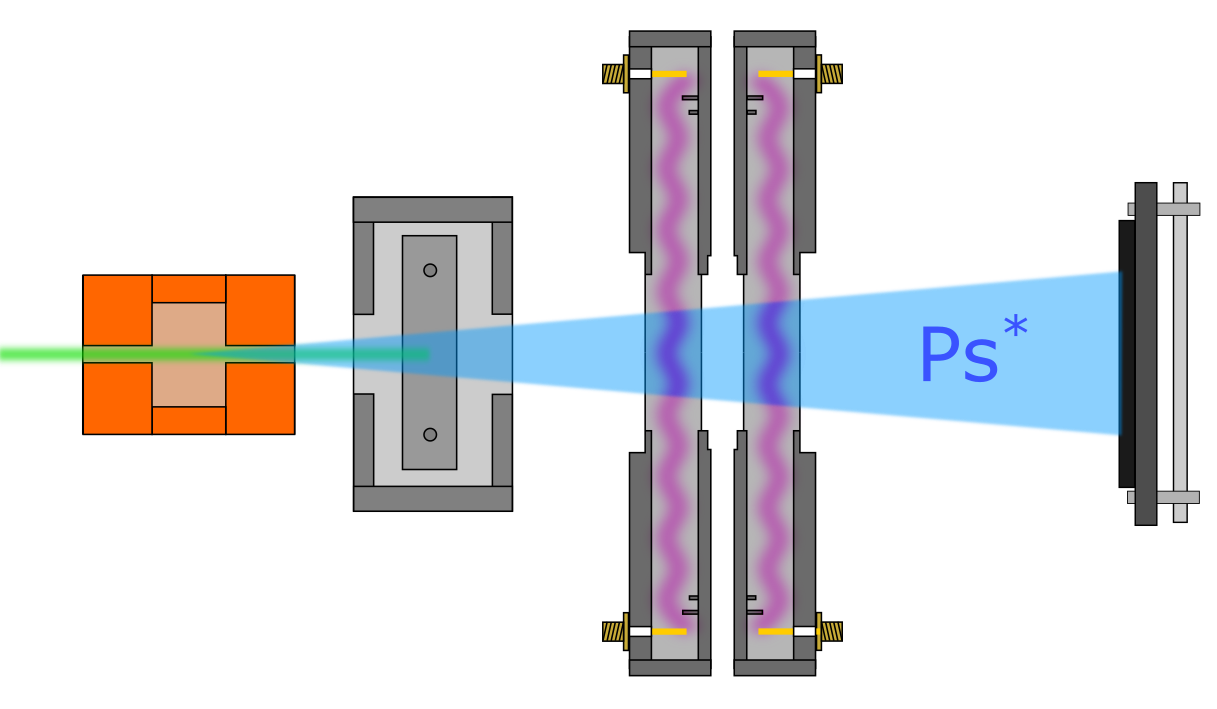
Precise measurements of energy intervals of positronium, the bound-state of an electron and a positron, can be used to test quantum electrodynamics theory and constrain parameters related to physics not included in the framework [1]. Despite this promise current measurements of the n=2 fine-structure...
Go to contribution page -
Ashot Gasparian (NCAT)
-
Bogdan Wojtsekhowski (Jefferson Lab), Prof. Ashot Gasparian (NCAT)
The search proposed here uses a missing mass method in one photon final state for a reaction of a positron-electron annihilation.Muon and electron g-2 measurements are the only other comparable approaches which are able to give a model independent constraint on the electron-axion (A’) coupling constant.The proposed experiment with a 100 MeV beam in 30-days run will reach a sensitivity for the...
Go to contribution page -
Wally Melnitchouk (Jefferson Lab)
We review the physics opportunities, both at high energies and low energies, that present themselves with a positron beam at Jefferson Lab.
Go to contribution page -
Dr David Mack (ODU and W&M)
I will describe how at least two large, double-spin Bhabha asymmetries can be used to measure the polarization of the e+ source. Meanwhile, the unique helicity amplitude structure of the parity conserving, singly- or doubly-helicity suppressed, transverse Bhabha asymmetries are sensitive to the introduction of non-QED elements such as scalars, tensors, etc. For e+ beam energies of 5-10 MeV...
Go to contribution page -
Concettina Sfienti (Johannes Gutenberg-Universität Mainz)
Precision electron scattering has long been a powerful tool to probe nuclear structure and reaction mechanisms relevant for nuclear astrophysics. At Mainz, the MAMI accelerator and the upcoming MESA facility provide unique opportunities for high-precision measurements at low energies. Dedicated experimental programs aim to investigate excited states in light nuclei as well as reaction cross...
Go to contribution page -
Paul Gueye (FRIB/MSU)
Charge form factors are fundamental observables for nuclear physics. Experimentally, few techniques can be used to probe nuclear charge distributions, the dominant ones being electron scattering, hadronic reactions or laser spectroscopy. The comparison between electrons and positrons provides a unique way to investigate higher order corrections to the Born approximation from which dispersive...
Go to contribution page -
Matteo Ronchi (University of Mainz)
-
Matteo Ronchi (Johannes Gutenberg University)
McMule (Monte Carlo for Muons and other Leptons) is a powerful tool for fully differential higher-order QED calculations of scattering and decay processes involving leptons. It provides various types of observables, such as cross-sections and branching ratios.
Go to contribution page
In this work we show, with McMule, the importance of the radiative corrections up to and including next-to-next-to leading order... -
Alex Bogacz (Jefferson Lab)
Here, we present a compact injector design within the LERF vault, which would serve both the 22 GeV CEBAF and the positron program; being synergistic with electron source required to produce positrons for Ce+BAF. The injector complex is arranged in a racetrack configuration hosting three, C-75 cryomodules, each providing 71 MeV energy boost. Starting with a ~10 MeV photo-injector, a final...
Go to contribution page -
Marcel Dickmann (University of the Bundeswehr Munich)
Positron annihilation spectroscopy (PAS) is a powerful, non-destructive method in modern materials science. Slow mono-energetic positron beams with variable energy enable depth-resolved characterization of atomistic open-volumes in solids. Positrons are highly sensitive to lattice defects, since they can be trapped at vacancies or vacancy clusters, resulting in a change of their lifetimes and...
Go to contribution page -
Dipangkar Dutta (Mississippi State University)
The physics program using the polarized low energy electron/positron beam at CE$^+$BAF will require multiple forms of precise beam polarimetry.
Go to contribution page
The spin dependent synchrotron radiation (SR), called “spin-light,” is a
well known phenomena routinely used to polarize electron/positron beams in
storage rings. The use of spin-light for monitoring beam polarization of
transversely polarized... -
Johannes Mitteneder (Universität der Bundeswehr München)
-
Johannes Mitteneder
Positron annihilation lifetime spectroscopy (PALS) is a powerful tool for investigating defects in various materials. In order to study inhomogeneous defect distributions, e.g., close to fatigue cracks or dispersive alloy using PALS, a monochromatic pulsed positron beam of variable energy with a diameter in the range of 1 µm and a pulse width of 150 ps FWHM required.
Go to contribution page
To this aim, the... -
Andrew Knights (McMaster University)
-
Concettina Sfienti (University of Mainz)
-
Christian Weiss (Jefferson Lab)
-
Prof. Ashot Gasparian (NCAT), Bogdan Wojtsekhowski (Jefferson Lab)
The 100-year old theory proposed by E. Fermi and further developed by Weizsaker and Williams can be tested by using Compton scattering of quasi-real photons from atomic electrons.Currently known tests have a few percent accuracy which could be improved by at least a factor of 10. The proposed experiment will use an H(e, e_1 + e_2 + \gamma) reaction with selection of the events with the...
Go to contribution page -
yves roblin (jefferson lab)
Jefferson Lab is proposing to add positron beams to the 12 GeV Continuous Electron Beam Accelerator Facility (CEBAF). We will introduce the concept for the generation, production and delivery of Continuous (CW) polarized positron beams to the experimental halls, up to the full 12 GeV. A layout of the proposed concept will be shown. We will report on the ongoing efforts in the positron...
Go to contribution page -
Win Lin (Stony Brook University)
The DarkLight experiment at the ARIEL facility at TRIUMF is designed to investigate beyond standard model physics at 10 to 20 MeV energy scale. Inspired by the anomalous signal observed in 8Be* decay by the ATOMKI group, DarkLight is searching for evidence of the possible new boson by measuring electron-positron pair production and reconstructing the photon mass using a two-spectrometer setup....
Go to contribution page -
Doris Jakubassa (University of Munich)
The beam-normal spin asymmetry for positrons scattering from the spin-zero nuclei $^{12}$C and $^{208}$Pb in the energy region below the pion production threshold is calculated by means of the phase-shift analysis, and its corrections from dispersion and from the QED effects are estimated.
Go to contribution page
For $^{12}$C both effects can be of comparable magnitude, typically in the percent region, but they... -
Doris Jakubassa (University of Munich)
-
Silviu Covrig Dusa (Jefferson Lab)
The Ce$^{+}$BAF group at Jefferson Lab is developing a solid rotating positron converter target as part of a future positron source at LERF. We are in the process of testing a prototype rotating target at LERF as a stepping stone towards a production positron target. I will present the status of the prototype target tests and of the production target design.
Go to contribution page -
Yuki Fukaya (Japan Atomic Energy Agency)
Total-reflection high-energy positron diffraction: Principle and application
Yuki Fukaya$^{1}$
$^{1}$Advanced Science Research Center, Japan Atomic Energy Agency, 2-4 Shirakata, Tokai, Naka, Ibaraki 319-1195, Japan
This study reports the principle of total-reflection high-energy positron diffraction (TRHEPD) method and its application to structure determination of two-dimensional (2D)...
Go to contribution page
Choose timezone
Your profile timezone: