If you would like to contribute a WG presentation, please contact WG conveners.
A mission of the TTC is to promote discussion on technical issues important to the community. Live presentation and in-person discussions are essential features in the TTC meeting.
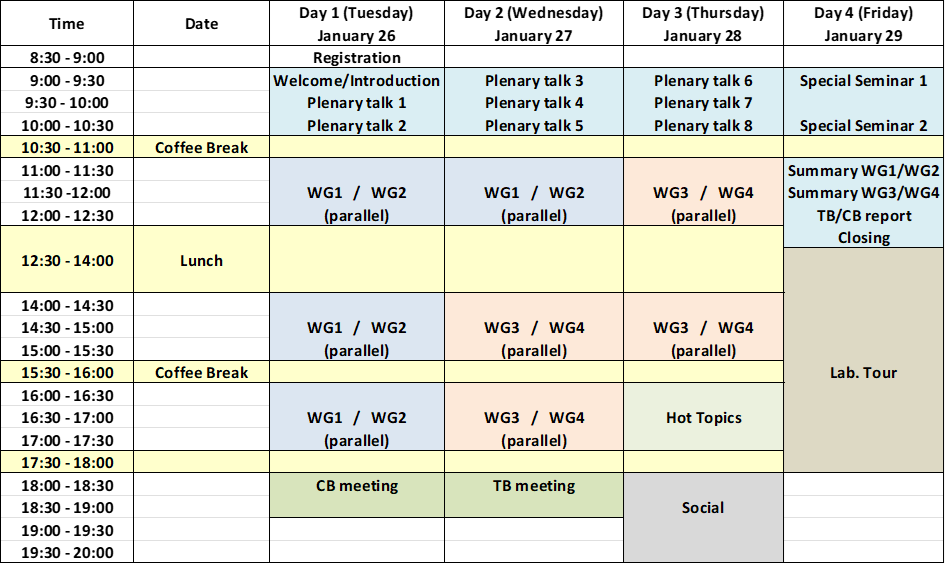
The charge statements for TTC2027 are written in the form of questions. We ask the conveners to form a program with short presentations followed by discussions to help provide answers for those questions. The conveners will also prepare a 15-minute summary of their WG discussions with answers to the charge questions on Friday morning.
WG-1: Understanding the recent High-Q/ High-G performance
Conveners: Eric Lechner (TJNAF), Kensei Umemori (KEK), Marc Wenskat (DESY)
This working group is tasked with improving our understanding of the mid-T bake process. The conveners are asked to guide the content and discussions to answer the key questions presented below:
- Are we converging on our understanding of the performance improvement from mid-T bake?
- Are we converging on the recipe? What R&D is missing?
- What are key differences in application/performance between mid-T and N-dope?
- What is necessary to transfer the process to industry?
- For the ordering of 100 new cavities for a pulsed / long-pulsed / cw project with a given Q, gradient, frequency which recipe would you choose – pros and cons
Keywords: bulk niobium, high Q, high G, doping, heat treatments, mid-T bake
WG-2: High power couplers and HOM couplers – RF and cryogenic performance
Conveners: Wencan Xu (BNL), Hassen Jenhani (CEA), Kazutaka Ozeki (RIKEN)
This working group is tasked with improving our understanding of the current state of high-power couplers (FPC and HOM) and how to incorporate them into cryomodules for low thermal impact. The conveners are asked to guide the content and discussions to answer the key questions presented below:
- What are the practical power limits in cw applications?
- What are the requirements for future projects – cw vs pulsed, power, frequency?
- What are the key design challenges?
- What are the key design choices to limit heat leak to
- reduce cryomodule static load
- allow cryocooler operation
- What is the world-wide availability of qualified vendors?
Keywords: fundamental power couplers, higher order mode couplers, thermal heat leaks, coupler vendors
WG-3: Standardization of VT protocols
Conveners: Kellen McGee (FNAL), Anna Shabalina (STFC), Hetaee Kim (IRIS-IBIS)
This working group is tasked with improving our understanding of the current state of the means and methods of SRF cavity vertical tests. The conveners are asked to guide the content and discussions to answer the key questions presented below:
- What are the recommended strategies for cooldown speeds & cavity temperature uniformity during cooldown?
- How do cooldown speeds differ between bulk niobium, Nb/Cu and Nb3Sn cavities?
- What are the recommended set of diagnostics required? For temperature, for remnant field, for flux expulsion, for field emission, for rf.
- What are the pros and cons between variable coupler and fixed coupler?
- How to define field emission free?
- What are the pros and cons between active or passive magnetic shields?
Keywords: cavity testing, cavity diagnostics, repeatability, cooldown protocol, magnetic pollution
WG-4: Origins of cavity degradation in cryomodule operation
Conveners: Aveen Mahon (TRIUMF), Naruhilo Sakamoto (RIKEN), Franck Peauger (CERN)
This working group is tasked with improving our understanding of the mechanisms that can trigger a reduction in SRF cavity performance during on-line/beam operation. The conveners are asked to guide the content and discussions to answer the key questions presented below:
- What is the origin of field emission?
- What events have been observed to trigger changes in field emission?
- What factors have been observed to cause degradation in Q0?
- What damages to components have occurred due to FE or other mechanism?
- Other issues with cavity systems.
Keywords: Field emission origin, field emission damage, Q0 degradation
Hot Topic Session:
Driving the SRF Frontier: AI/ML Strategies for SRF Applications
Convener: Sebastian Aderhold (SLAC)
Artificial Intelligence (AI) and Machine Learning (ML) are rapidly shifting from experimental data analysis tools into core drivers of innovation across particle accelerator laboratories worldwide. However, significant challenges remain in moving from ad-hoc algorithm demonstrations to robust, real-time integration within high-availability accelerator environments. While progress is varied one reality is clear: the AI/ML transition is happening, and accelerator technology must adapt.
The goal of this Hot Topic session is to discuss present deployments and forecasted potential for the utilization of AI/ML methodologies in the SRF community and the path forward for embedding AI/ML into operational SRF control frameworks.
Some suggested talking points are given below:
- How are AI/ML methodologies being used in present SRF applications?
- What applications are envisaged for the future?
- What critical R&D, data infrastructure, controls systems are required?
- Is there a standardization foreseen where applications could be deployed broadly across multiple projects?
- What data-sharing protocols, algorithmic validations would be required?
- How can physics informed models be incorporated into SRF applications (LLRF automation, digital twins, predictive diagnostics …)?
- Applications for consideration: Autonomous performance tuning, Automated fault classification, Accelerated cavity design, Enhanced cavity stability, Optimized surface processing, cobot oversight …
Keywords: AI/ML in SRF, real-time LLRF control, microphonic compensation, fault classification, quench mitigation, physics-informed surrogate models, digital twins, virtual diagnostics, autonomous operations, standardized data infrastructure